Maple Wine 1.0

Maple Wine 1.0

Ingredients (Per Gallon)

  • 1 quart Maple Syrup
  • 1 Packet of Mangrove Jacks Mead Yeast
  • 1 TSP Yeast Nutrient
  • 1 Camden Tablet 
  • 1 Cup of maple syrup (to Back-Sweeten)

Fermentation Timeline

  • End of Primary: Day 22
  • End of Secondary: Day 30
  • Ready to Drink: Day 180

Making Wine from Maple Syrup 

I became obsessed with Maple trees this year. It’s not a healthy obsession by any means, and it will eventually lead me to attempt making maple syrup over the winter. However, since there is plenty of time yet to wait for that, I planned out a Maple Wine made from store bought maple syrup.  

Maple wine is surprisingly quick and easy to make, even more so than Mead in my opinion. It ferments from 1.10SG, to .990SG in about three weeks, and clears nearly completely within 20 days of the first racking.  If I can stomach that timeline, any reasonably patient person will think this is a breeze.

On brew day, I started by taking one quart of store bought maple syrup, and adding it to my fermenter. Next I filled up my fermenter two thirds of the way up, with the intention of shaking it to aerate and mix in the maple syrup. Then I remembered how poorly this had gone while I was sanitizing the fermenter.  I had given myself a splash while shaking the sanitizer filled jar (lid attached), and so as to not repeat the process with sticky syrup water, I decided to use a whisk instead.  I topped off my fermenter with a bit more water and realized that I had created a beautiful dark golden brown elixir, with great potential (alcohol).  

The next step was to take a gravity reading, which was 1.100sg, i.e. a 13% potential alcohol content.  This was most satisfactory. I then made a quick rehydration jacuzzi for the yeast using the gravity sample. I then added half a packet of Mangrove Jacks Mead yeast.  A few minutes after the first signs of life, the yeast slurry was poured into the fermenter along with one teaspoon of yeast nutrient.  I gave it another quick stir, put the lid and airlock on, and put it away to ferment.  Like I said earlier, this is SUPER easy.

I started to see signs of activity the next morning, as bubbles came plopping out of the air lock. One by one, with each adorable little thump, I knew the yeast were hard at work lowering the gravity of the Maple wine must.  They continued on, I was able to monitor the first three days of the fermentation before going to work for several days.  When I came back there was significantly less activity.  I continued to let it sit for a total of 22 days before I decided to check the gravity.  The lack of activity in the air lock did not lie, there was no sugar left in the must.  The gravity had dropped to 0.990!  I then racked the already semi clear wine into a clean fermenter so that it could age and clear.

Clearing occurred much more quickly than I had anticipated, lasting a total of 20 days (not 15). There was not much more than a light dusting of sediment at the bottom of the jar, and you could see right through the jug, like an amber magnifying glass.  I once again racked the wine but this time I collected a small sample in my favorite whiskey glass to try out.  Before I tasted my sample, I added a campden tablet to the freshly racked wine and re covered it with the lid and airlock.  

I had a pretty good idea what to expect from the sample in terms of flavor and experience, just based on the gravity.  Shure enough, there was far more heat than flavor.  I believe I described it as “drinking dragons fire.”  Mind you, it had been nearly two years since my last sip of anything alcoholic.  It is possible that I could have just forgotten what it felt like to drink. However, I am mostly certain, that the maple wine was really just far too dry at this point to enjoy. Luckily, I knew how to fix that.

After waiting the required 24 hours since adding my Camden tablet, I grabbed a new bottle of maple syrup and started to adjust the sweetness of the wine.  This process is called back sweetening.  In the video I claimed that i was adding 1/4 cup at a time, but this was incorrect.  I discovered while doing dishes that night, I had actually been using a 1/3 cup measuring cup (oops).  Not to worry, the result was all the same, however the correct unit of measurement should be noted so you can all have a similar result to mine.  I took a couple samples and was satisfied once I had added one cup of maple syrup.  After back sweetening the gravity was 1.010.

I decided to wait a week before bottling to make sure there was no evidence of fermentation, and luckily there was none! I then saddled up the auto siphon and a few bottles and corks.  After all was said and done, I ended up with 4 and a half bottles of crystal clear maple wine!  

This project was a great way to get back into home brewing after taking a three year break!  I would highly recommend this as a project for anyone just getting started as well.  If you liked what you read here, please go check out the video on You Tube so you can observe my mistakes in 4k!  Thanks for reading!
I’m Back!

Howdy Ya’ll!

It seems like it has been a while, but after an extended break from brewing and an ongoing slow down and change of drinking habits, I am once again up to no good! Today I cleaned out my old stash of one gallon fermenters (I sold the big stuff at a yard sale about a year and a half ago), and am working on some brainstorming for new Ideas. Some of which are not related to home brewing specifically, but I believe will still provide some entertainment as they share similar processes to beer brewing.

The last couple years have been a good break, there were significant changes in my personal and professional life that are allowing me to feel and be a better person for my family. I started a new job (possibly the dream job) and stopped drinking, made healthy lifestyle changes, lost a bunch of weight, and made my life better overall.

Yesterday I pulled the trigger on buying back the basic tools that I needed to start making small batches of beer and wine. I’m going really cheap this time and starting out with one gallon batches. At the moment, I am not really drinking, and aside from having a glass here or there during filming a taste test, I am not likely ready for recreational drinking yet. I am, however, quite ready to start doing science experiments in my kitchen again. One gallon batches (for the moment) are the perfect size for me.

I look forward to possibly engaging with you all in the comments on You Tube, or here on my site, while I start to spin up the ol’ engine again!

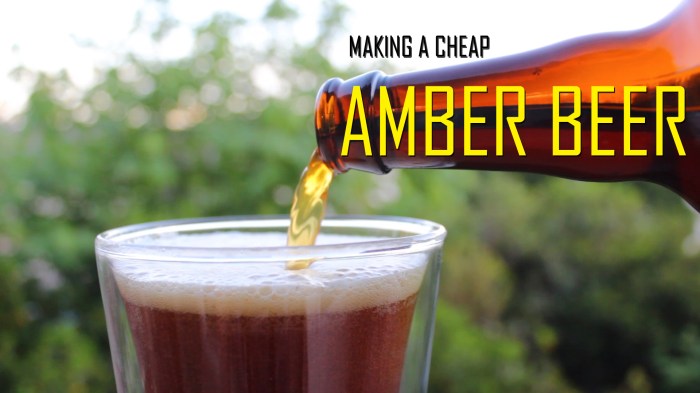
Making A Cheap Amber Beer

INGREDIENTS

  • -1lb American Crystal 40 Barley (NOT milled)
  • 8oz Bavarian Wheat Dry Malt Extract
  • 1lb Pilsen Dry Malt Extract
  • 3/4 oz Cascade Whole leaf hops (1 1/2 Cups)
  • Cellar Science Berlin Lager Yeast
  • 1oz Corn Sugar (for Priming)
  • 6qt Water

BREW TIMELINE

  • Steep 1lb American Crystal 40 Barley (20 minutes)
    • 150-165 Degrees
  • Rinse the steeped grains with two quarts of water, then add the malt extracts.
  • Boil for 60 minutes
    • add 1/4oz Cascade hops with 60 minutes remaining
    • add 1/2 oz Cascade hops with 15 minutes remaining
  • Chill the wort in an ice bath (20-30 minutes)
  • Add wort to fermenter, strain the hops out, squish them for extra wort.

Fermentation Timeline

  • Primary: 15 days
  • Secondary/carbonation: 15 days
  • Enjoy after 30 days

HOW TO MAKE A CHEAP AMBER BEER

If you’re here because you want to experiment with making beer and are too proud to buy a kit, then you are in the right spot. One day I decided that I was too proud to buy a kit and the result was actually not too bad! So don’t be worried about screwing up your first beer, just order some grain and let the chaos commence! For this project you will need a one gallon fermenter, a large pot (6-8qt capacity), a meat thermometer, an auto siphon, a kitchen scale, and a muslin bag to hold the grain. If you want to bottle the beer then you’ll need five 22oz beer bottles, one 12oz beer bottle, 6 bottle caps, and a bottle cap crimper. As far as the yeast for this project I used a lager yeast which works best in colder temperatures. Somewhere the 50 to 60 degree range. Now that you know that please promptly stuff it in the back of your head for some other time. You will find, just as I have, that lager yeast work just fine at room temperature. More than fine actually.

I started by grabbing a somewhat small pot and bringing about two quarts of water up to a temperature of 150-160 degrees. I used that temperature to help get the sugars in the grain to come out. I then added my one pound of American Crystal 40 to the muslin bag and steeped it for twenty minutes. For this project I had pretty poor temperature control during my brew, so the pot got up to about 168 degrees during the steeping. To be honest I don’t think it made much of a difference, but I did come up with the idea to use the smaller burner on my stove instead of the larger one. In a future brew that technique proved to be a much more effective way to control the temperature in the brew kettle. After twenty minutes had passed I took my bag of grain out of the pot and held it over my larger brewing pot to drain. As it was draining I filled up a mason jar with tap water and poured two quarts of water over the grain to get any additional sugar out. If this is your first beer attempt, and you don’t know any better, it’s not a good idea to squeeze the grain bag to get all the water out. Squeezing the grain can release some of the tannins in the grain and that can cause your brew to have off flavors. Instead, rinse (or lauter) the grains with some water, like I did. #themoreyouknow

Now that I had some beautiful barley tea in one pot, and some barley flavored water in my brew kettle, it was time to combine them in the big pot. I set my burner on high and added my dry malt extracts, stirring until dissolved. This was the beginning of the boil. One note about the boil is that you will experience a significant loss of water. I expected this and added an extra quart of water into the pot, bringing the volume of liquid up to five quarts. As the water was coming up to a boil I recall that it did not smell like I had anticipated, and the wort was starting to look like coffee that had maybe a little too much cream in it. I did not anticipate that either, but nevertheless I continued. The timer was set for sixty minutes, it was time to add my first round of hops. I measured out and added one half cup of Cascade hops at the very beginning of the boil. The next round of hops I added was one cup with 15 minutes left in the boil.

Around the same time as I added the last hop addition I started getting my sink ready to help cool down the wort. I had been preparing to do this for a couple days by saving up some Ice cubes in a zip lock bag. I then poured them into my sink after filling it with cold water. Once the sixty minutes of boiling was done I took the pot and placed it in my sink, covering it with a lid to reduce the risk of bugs and bacteria getting into it. It only took me twenty minutes to cool down the wort to 75 degrees. It worked much better than I expected. I grabbed a funnel and a strainer and started pouring my wort into the fermenter. I’d like to take a minute to call back to the boil phase where I said that I had anticipated losing some wort due to boil off. Originally, I had thought that I would only lose a quart. That was incorrect. Even after squeezing the hops for every last drop of precious wort that I could get, I was only able to fill the fermenter to about 60%. I had to add almost two quarts to fill the fermenter which caused the gravity to drop significantly. 1.035 was my starting gravity, a potential ABV of 5% which I figured would probably not ferment out all the way. Before I added the yeast I shook the fermenter for about a minute to get some oxygen into the wort. Finally I added half-ish of my lager yeast directly from the package into the fermenter, slapped an air lock on it and stuck it outside in my storage closet. See ya in fifteen days beer!

Wrong, I checked on the beer the next morning and discovered that some sugar ants were attempting to get into the air lock. I guess that is why we use air locks! I brought the beer inside and set it on the counter to finish. Not too much later the air lock was filled with foam and beer. It was like a beer fountain, which would be cool if it was coming from a keg and not my fermenter. I had read online about something called a blowoff tube that was a pretty typical solution to my beer fountain. I did a little bit of research on it and got to work engineering one. Essentially all I did I was cut about 9 inches of PVC tubing off my auto siphon and ran it from my empty air lock into a mason jar filled with water. Luckily my 1/4 inch PVC tubing fit perfectly on the little nub in my airlock and this worked like a charm. I needed it for about three days and then the fermentation calmed down. I was then able to set it back up normally. My wife was happy to have some of the counter space back too. For the rest of the fermentation, which was fifteen days in total, I had the beer covered with a paper bag so that the yeast were not exposed to light. In order to get some B roll footage for the video however, I did remove it several times and I honestly don’t think it made any difference at all.

On the fifteenth day I was super stoked because it was time to bottle and prime the beer for carbonation. I gathered up five 22oz beer bottles, one 12oz beer bottle, some bottle caps, and my bottle cap crimper. For this particular project I went with in bottle carbonation, which is when you give the yeast a little boost of sugar and seal them in the beer bottle. They’ll eat the extra sugar and produce some more Co2, which will be trapped inside your bottle and then be absorbed into the liquid as the pressure increases in the bottle. To get started with that I measured out .8oz of corn sugar. If you don’t have a kitchen scale then you can use approximately 3 to 4 tablespoons of corn sugar. I added the sugar to half a cup of boiling water, stirred it till it was dissolved and then added it to a pot. The pot was going to serve as my bottling pot so I racked the beer out of the primary fermenter and into the pot where it mixed with the priming sugar. I took a quick gravity reading of the pot and came up with 1.019. That would make it about 2-3% ABV, but one thing to note is that when I took the gravity reading I had already mixed the priming sugar into it. The priming sugar is only going to add about .003 points to the gravity but it does fudge the actual gravity number a little bit.

I successfully bottled five 22oz bottles and part of a 12 oz bottle, only spilling a little bit on the floor. The sad part is that even though the beer is in the bottle it still has to sit for at least two weeks to become fully carbonated. I tucked the beer away in my ant infested storage closet and let it do its thing for 15 days. Not a single day beyond fifteen days I opened up my closet door to find that not only were the ants gone, but my beer was happy to see me as well. What a wonderful day to be alive it was. No bottle’s were broken, no ants crawling on them. The only thing left to do was to taste it.

To my surprise it was actually pretty good! My video was good too. I had the perfect sunset, the lighting was spectacular, and I didn’t stumble over my words too much either! I came back in bragging about it to my wife and then immediately sat down at the computer to finish the video. Upon opening the files on my SD card I found that they were all completely corrupted, sweet. It must have been those damn ants! I was pretty upset about it because my reaction was genuinely happy and now I had to fake it for the camera. Sorry to ruin the illusion for those of you who watched the video. I was hoping for another good sunset the next day and I got a pretty decent one with good lighting thankfully. Now that I am done complaining, let me tell you about the beer.

It had a nice amber color and a nice grainy smell, almost like a stout. Stout notes were confirmed when I tasted it. It was just a tiny bit more “stouty” than I would have liked, but it was still pretty darn good for just one type of grain and some randomly picked malt extracts. If this project proved anything to me, it’s that it is much harder to screw up a beer than I had originally anticipated. The only hard part really is when you’re finished with the last bottle.

Cheap Traditional Mead

Ingredients for a One Gallon Batch

-3 pounds of Clover Honey

-Lalvin 71B (Lalvin D47 preferred)

-1 TBS Yeast Nutrient (I used bread yeast for this)

Fermentation

Primary: 40 Days

Secondary: 3 Days (Should be more like 3 weeks)

Aged: 6 months

how to Make a Cheap One Gallon Mead

Hey everybody welcome to cheap brew, I am Anthony and what you are about to read is one way (not necessarily a good way) to make a traditional mead. Above you can see the ingredients I used for this project as well as my fermentation timeline. The only thing left is to talk about the equipment you’ll need, so lets get into that. In homebrewing there are a few tools that I have come to find essential based solely on this project. Those things are a fermentation vessel, some sanitizer, a pot, and an auto siphon. You can go without an auto siphon (as you can see in my video), but it’s not going to give you the best result unless you like drinking yeast.

The first thing I did with this mead was to mix the honey and water together in a pot. I used roughly half a gallon of water which I then brought up to a boil. Not for the honey though. Please don’t boil that. The reason I boiled the water was so that I could add some bread yeast and boil them to death. That sounds harsh but yeast are cannibals and the internet said they make a good yeast nutrient. Whereas I didn’t have any yeast nutrient available this seemed like a reasonable thing to do. I can neither confirm nor deny that it made any difference whatsoever aside from adding the slight flavor of bread yeast. You can do what I did, but you might be better off to use raisins or actual yeast nutrient.

After murdering some bread yeast I lowered the heat and let the water stop boiling. After a couple minutes I then added three pounds of clover honey that I bought from Wal Mart. Stir this until the honey is dissolved. You will probably fall in love with the smell as you are doing this step, that is unless you are using bread yeast as a yeast nutrient. It should smell really sweet, like an herbal tea. It’s quite comforting. Once you’re done mixing pour the must into your fermenter. It would be a good idea to use a big funnel if you don’t have a wide mouth fermenter (or you can use an auto siphon). What you should not do, which I did, is add the honey must to the fermenter with water already inside it to attempt to get a 100 degree temperature to pitch your yeast sooner. It might overfill, so it’s better to add what is in your pot and then backfill with cold water until the fermenter is about 80 or 85% full.

Next, its time to activate your yeast! I have taken a liking to Lalvin D47 for meads, but for this one I was inexperienced, and I used the wine yeast I got from the home brew store that I intended to use on a different project. This wasn’t necessarily a bad choice, but if you do it you should try some Lalvin D47. There are usually instructions on the back side of the Yeast packet but if all else fails just take some of your honey water and put it in a small bowl then dump the yeast on it so they can rehydrate. You can also do what I did for this project and just use a small bowl and some warm water. Either way will work, it’s not rocket science.

After about 20 minutes passed for yeast hydration I decided it was time to add the yeast to the honey must. The temperature of the must was around 100 degrees when I did this. I wanted to make sure the yeast had some oxygen to use during fermentation (the yeast use it during fermentation) so I shook the jar around for about a minute and then added the air lock. That’s about all there is to making mead, at least to get it started. It can require a bit more finesse later on in the project than what I was able to give this poor mead.

After about 6 weeks of fermentation and a 25 mile car ride to my new apartment, it was time to rack the mead so it could clear for a little while. This was the step that caused me the most grief in the long run. In any brew you should try to keep things as sanitary as possible, which means you should not rack a brew using the old fashion gas siphoning technique. That’s right, I used my mouth and applied suction to one end of some pvc tubing. I sanitized mu mouth with a shot of straight Tequila first, but it was not enough. There was either bacteria on the tubing or the two bowls I used to hold the mead while I was rinsing the fermenter. Somewhere along the line I helped a little bacteria family start a colony. I just didn’t know it at the time. I used a funnel to help me get all the mead back into the fermenter and let it sit for a total of three more days to clear, which was also a mistake. It would have been better to leave it for more like three weeks, but this is how we learn.

“It looks really clear,” is what I recall myself saying, but as a more seasoned home brewer looking back on his first real project I know now that it looked kind of hazy still. However, in my mind, three days had passed and it was time to put the mead into bottles. How did I bottle without an auto siphon and bottle filler, you might ask. I used a my trusty funnel and poured the mead into the bottles. The first two bottles were “really clear.” For the second two the motion of my repeated pouring had mixed the yeast back into the mead. I now had two bottles that were very hazy and two that were clear to what was then my standards.

I was so pleased with myself. I put the bottles on display, leaving them out on the counter with their cool little labels so I could look at them while I was grabbing my evening whiskey. But one night I noticed a small layer of scum forming at the top of the bottle. On the inside. I didn’t mention it in the video but I had noticed the same substance during the fermentation as well. I did what any good home brew novice would do and I googled bacteria infections in mead and found some strikingly similar results. I looked for ways to fix it for a long time and finally settled on one irritating option. Pasteurization.

There were a few things that worried me about pasteurization, first and foremost was the possibility of having less wine than I started with. The second was losing alcohol content. Alcohol boils at 173 degrees and to kill bacteria you need to hit 140-160 for at least a minute. I thought that was pretty close but it was a risk that I took anyways, and it was a success. There was no need for me to go through that if I had just had an auto siphon but after I put the wine back into the bottle there was no more growth. And any yeast that was alive during the boil died with the bacteria. After that, clearing was rather expeditious. There was one problem though. Once everything was cleared there was a massive pile of loose debris at the bottom of the bottle. Oh if only I had just let it clear longer.

Six months went by before I was daring enough to open a bottle of my franken-mead. I will say I was pleasantly surprised by it, even if it was pretty obvious that I had used bread yeast as a nutrient and left a thick layer of dead yeast in the bottom of the bottle for six months. The taste of that was a little off putting, but I was able to eventually enjoy all four bottles with some careful pouring. The lesson to be learned for this project is that if you’re going to make a mead the cheapest way possible you will still need an auto siphon.